Revolution or Police State? Beware the Pitchforks!
Note: Six years ago in September 1996 I posted the following commentary. What purveyor Nick Hanauer wasn’t able to predict was that the metaphorical “pitchforks” did make a sudden and alarming arrival, but not in the capacity of his prediction. The January 2021 storming of the Capitol in Washington, D.C., brought America temporarily to its knees politically. The fallout through the justice system and the alarming promotion of more violence by former president Donald Trump places a question mark on what’s next. More specifically, when do Hanauer’s pitchforks held by Americans protesting income inequality appear? Read on for some background and context.

You show me a highly unequal society, and I will show you a police state. Or an uprising….It’s not if, it’s when. (Nick Hanauer)
It’s not often that you get a really rich person talking publicly about the dangers of growing income inequality in the United States. And especially the consequences of looming social unrest. Come to think of it, we never hear someone in the super rich club talking about the need to rebuild the middle class and to seriously address the huge numbers of Americans who live in, and at near, poverty.
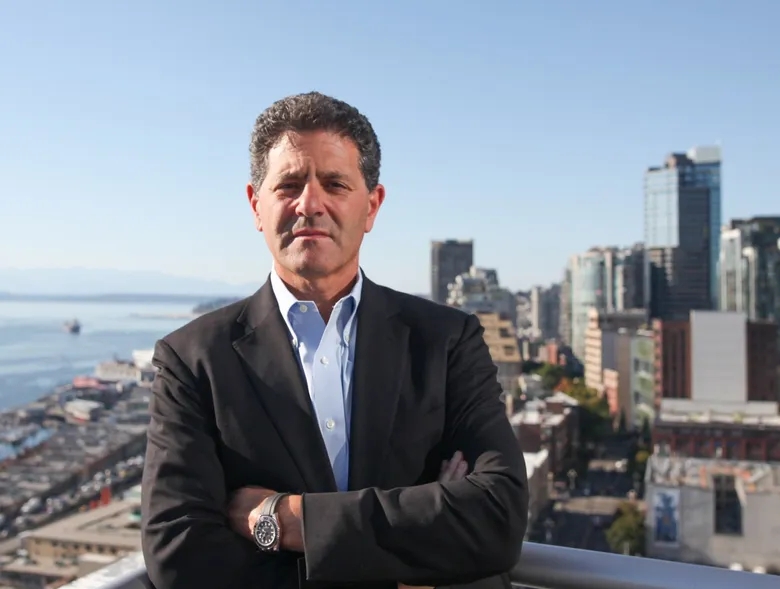
Well, there’s one rich guy who not only gets it but who has increasingly become more Nick Hanauer vocal for a call to action by America’s elected representatives and business people. Meet, author of the opening quotation. (It should be acknowledged that investor and philanthropist Warren Buffet has spoken about America’s warped taxation system that favours the wealthy.)
Hanauer, age 57, was born in New York City (photo below). An average student, he earned a philosophy degree from the University of Washington. After graduating, he began work at his family-owned Pacific Coast Feather Company; he’s still the CEO and co-chairman. However, when he was a young man he displayed what he’s acknowledged as an appetite for risk, and began investing in numerous ventures over the years. One of his early investments was Amazon, serving as an advisor until 2000. He created Gear.com, which later merged with Overstock.com. Many other ventures line Hanauer’s CV, but of interest was his forming The True Patriot Network, a political action tank. He also helped create The League of Education Voters in the state of Washington.
An advocate of a higher minimum wage, Hanauer wrote a commentary in 2013 for Bloomberg BusinessWeek, in which he proposed a $15 minimum wage. The following year, Hanauer and Eric Beinhocker published Capitalism Redefined. This is recommended reading. However, it was Hanauer’s commentary featured as a special report in Politico that caused people to sit up and pay attention.
The Pitchforks are Coming…for us Plutocrats is an in-your-face, frank assessment of where America is at on the issue of income distribution. You can also listen to Hanauer in this TED Talk, where he makes an appeal to his “fellow plutocrats” to help initiate the needed socio-economic changes to reduce income inequality. Be sure to take to watch this illuminating video.
A contentious public figure in the past few years, owing to his TED Talks and media interviews, Hanauer’s viewed by right-wing capitalists, and many Republicans, as too left-leaning and too critical of America’s capitalist society. Based on developments over the past 20 years, from NAFTA to China’s entry to the World Trade Organization to the 2008 financial meltdown and ensuing Great Recession to the Occupy Movement to the proposed Trans Pacific Partnership, these criticisms hold little substance. American workers, especially those in manufacturing and information services, have gotten screwed.
Hanauer points out that in 1980 one percent of the U.S. population controlled eight percent of the national income. The bottom 50 percent held 18 percent. Fast forward to today and the top one percent controls 20 percent (up 12 points); in contrast, the bottom half has only 12 percent (down six points). However, of more relevance than these numbers is understanding the distinction between income and wealth.
To be in the one percent club required an annual cash income of $500,000 plus in 2008. However, at the core of the one percent issue is wealth, encompassing assets less liabilities. On that front, one percent of Americans control about 35 percent of the country’s wealth. However, that share of the nation’s wealth has barely budged upwards since 1962 (only 2.2 percentage points). Wealth begets more wealth. It’s the massive disproportionate increase in income by the one percent between 1979 and 2007, up 275 percent, that raises eyebrows—and tempers. The middle class, in comparison saw its income rise by just under 40 percent.
The middle class has been squeezed relentlessly not just in the U.S. but in Canada, the UK, Europe, Australia and New Zealand, with wages stagnating in real terms, young people being underemployed and older workers being thrown to the curb as work is outsourced overseas. No wonder why Great Britons voted to exit the European Union (aka Brexit), when one considers how the country has been hammered economically outside of metropolitan London.

One can pick at some of Hanauer’s arguments, but the underlying point is that American society, as we’ve come to see it evolve into a post-WWII healthy middle class, is under extreme threat. The work of Presidents Eisenhower, Kennedy, Johnson, Nixon, and Carter started to unravel with the later introduction of trade agreements that saw jobs outsourced overseas. President Reagan, who oversaw the growth of the U.S. debt by $1.86 trillion (more than even President G.W. Bush), did take on the Soviets and through a sustained effort with Mikhail Gorbachev saw a large reduction nuclear weapons.
It was under Presidents H.W. Bush, Clinton and G.W. Bush that China’s massive manufacturing hub was created and took hold. President Clinton, many have forgotten, signed the legislation to eliminate the Glass-Steagall act of 1933 (enacted under President Roosevelt) which was aimed at separating consumer banking from investment banking. And President G.W. Bush and his successor Barak Obama didn’t have much of a clue when it came to economics. In short, for the past two decades-plus it has been America’s plutocracy that has controlled the way forward for the US economy, and by extension Canada.
We hear about the “One Percent,” as portrayed by the Occupy movement” that not only spread across the U.S. and Canada but Europe, the UK, Australia, India, Brazil, Argentina and many more countries. But what’s really at issue is the .01 percent, the super rich who benefitted mightily from the exploitation of consumer debt, initiated by CITI bank.
Many people have attributed the expression “The One Percent” to nobel prize winning economist Joseph Stiglitz. While Stieglitz is a perceptive commentator on the socio-economic-class tensions prevailing in the US, it was actually President Franklin Roosevelt who coined the expression in the summer of 1914. It was at a public address in Reading, Pennsylvania, just when WWI was breaking out in Europe, and Roosevelt as Assistant Secretary of the Navy remarked in his address:
“There have been two kinds of successful politics devised in our system of government…. The first is the kind which seeks to build up party strength by obtaining … power based on the personal domination of a few men and the perpetuation in places of authority of those few men and their own appointed successors. That has been in the past, we must admit to our shame, a successful kind of politics, but the day of its success has just about come to an end…. The administration believes that the national government should be conducted for the benefit of the 99 per cent, and not, as has been sometimes been the case in the past, for the benefit of the 1 per cent….” (from Young Mr. Roosevelt, by Stanley Weintraub).
This is not the first time in history since the Industrial Revolution where extreme income and wealth inequality have become incendiary issues. Yet we, as human beings, like to consider ourselves as more sophisticated and educated compared to our forebears in the early 1900s and during the 1800s. We shouldn’t congratulate ourselves or feel superior, given our technology advancements. As a 21st Century society we’ve actually fallen backwards. The longer we wait to seriously correct the disparities in the economy, labor market and financial system, the longer and more difficult will be the road back. Hanauer’s correct about the metaphorical pitchforks. One has only to read some history on what happens when repressed people finally stand up and assert themselves.
The most ironic thing about rising inequality is how completely unnecessary and self-defeating it is. If we do something about it, if we adjust our policies in the way that, say, Franklin D. Roosevelt did during the Great Depression—so that we help the 99 percent and preempt the revolutionaries and crazies, the ones with the pitchforks—that will be the best thing possible for us rich folks, too. It’s not just that we’ll escape with our lives; it’s that we’ll almost certainly get even richer. — Nick Hanauer (from “The Pitchforks are Coming”)

Connect with Jim on Twitter @jlctaggart and LinkedIn
How’s Cubicle Life Going for You?

Dateline: May 16, 2018
This was the publication date of the following leadership post on the continuing squeeze on workspace footprints and the implications for wellness, productivity and creativity. Now over four years later, with half of this time immersed in a global pandemic, we’ve witnessed a rethinking of having white collar workers stuck in offices, crammed into smaller and smaller work spaces. Of course, those who’ve had to continue working in frontline occupations—from nurses, doctors and paramedics to hospitality and retail employees to public transit drivers—are not part of the teleworking conversation. More employers are now insisting that workers return to the office at least in hybrid form, and some want them back either fully in the workplace. As you read this not very old, slightly updated post, it does seem ancient in some ways.
One of my favourite Dilbert cartoons is from many years ago. Dilbert’s peering over his cubicle into the next one, asking the occupant: “What are you in for?”
Those five words sum up beautifully what has evolved–devolved?–over the past many decades in cubicle land. Your faithful correspondent was a cubicle dweller for much of three decades, starting in the private sector and then doing a long stretch with the federal government. In the eighties and nineties, cubby holes–cubicles–were small enough, but tolerable.
However, as the year 2000 receded in the rearview mirror, plans were underway in the public sector and in business to start squeezing office workers’ space, reducing their “physical footprint” to the smallest possible. All this has occurred while the remuneration packages of top management ballooned.
Once upon a time, people worked in huge open areas without zero privacy. And then came the cubicle some 60 years ago. But where did the idea of the cubicle start?
The irony of the cubicle concept is that it was intended to boost productivity, or so thought Robert Propst, a designer for office furniture manufacturer Herman Miller.

Propst, an inventor of heart valves and airplane components, wanted to improve efficiency over the bull-pen work setting that had been used for years. He designed what was called the Action Office, consisting of a large adjustable desk with vertical filing systems, separated from adjacent workers. It was about creating a semblance of privacy, with the belief that people would increase their productivity. For one thing, spreading out work (paper) on a large desk would supposedly produce more employee output.
By 1970, the Action Office concept had fizzled. Herman Miller then introduced what could be contemporarily deemed 2.0 – a compact modular cubicle with no adjustable desk. Management much preferred this model, since more workers were now compressed into the same physical space, plus managers benefited from having offices on the perimeter with windows. Other companies jumped into the now more lucrative office furniture market, most notably Steelcase.
Cubicle Land was born, and there was a lot of money to be made by manufacturers.
Of particular note, Propst later referred to his Action Office creation as a “monolithic insanity.”
Yet Propst’ monoliths now encompass some 40 million American workers; in Canada, that number would be around five million—or at least until Covid hit in the spring of 2020, whose effects are still not clear on the return to work and the degree of hybrid and total telework that will eventually settle in.

Some in the past have cynically referred to cubicle dwellers as The Walking Dead, given how working in such conditions eventually sucks out one’s spirit, wellness and creativity. The latter is of particular mention from a business perspective. Add in the bottom line metric of productivity, and the pernicious effects that cubicles have on it, and it offers up the question: doesn’t top management get it? Well, again thanks to Covid management is now trying to respond to the memo.
Silicon Valley has had a love affair with creating open office layouts, moving from slice and dice cubicles to employees not only working often at big tables but who are constantly on the move, changing on-site work locations regularly. Some companies started using the cubicle hotel concept, in which employees work at various tiny cubicles. No one has a “home.” This concept has started to gain traction as organizations emerge from the pandemic.
It doesn’t require a doctorate in organizational behaviour or psychology to understand that the bottom-line management fixation on squeezing as much space as possible from office floor design has had a negative effect on worker morale, wellness and productivity. Sure, open communication and team work are essential to organizational effectiveness and output. Except that senior management loves its emoluments – the perks – which it sees as a right when in reality they’re a privilege. In the vernacular, the people at the top aren’t practicing what they’re preaching. Fortunately, some smart companies have eliminated closed offices for management, forcing managers and executives to join the ranks of employees in open space designs.
It’s indeed difficult to espouse transparency, leadership and teamwork when senior management is not practicing it.
The steady move to continue shrinking individual worker space has occurred simultaneously with the ominous trend of creating a just-in-time workforce, in which people never hold permanent jobs, instead moving from contract to contract (creating huge retirement income problems down the road). That trend has been in play for several years.
The big question is what’s the long-term view (15 to 20 years out) of the open office concept, especially in a hoped for post-pandemic environment? What’s being debated now may prove to be a moot point in the bigger picture of Canadian and American workers’ roles in a global, technologically-driven labor market.
We need to give each other the space to grow, to be ourselves, to exercise our diversity. We need to give each other space so that we may both give and receive such beautiful things as ideas, openness, dignity, joy, healing, and inclusion. – Max de Pree (Retired, Former CEO, Herman Miller)

Connect with Jim on Twitter @jlctaggart and LinkedIn

One of the brighter lights in the management/leadership literature is Henry Mintzberg, Cleghorn professor of Management Studies at McGill University in Montreal since 1968. Mintzberg, age 82, is one of my top favourite thinkers and writers in this field. His grounded approach to the practice of management, based on four decades of empirical research, combined with his teaching and the authoring of 15 books, make him one of the world’s leading authorities. His book Managing is a cogent examination of the management and leadership fields. It’s a must-read by any serious student of leader.
Mintzberg has railed against MBA programs for the past 30 years, noting the technicians that are produced, capable of the analytics but sadly lacking in the experience-required aspects of people leadership. The good news is that MBA programs in North America have been steadily revamping their course content. An added benefit is that MBA students are increasingly people with some measure of real world work experience.
In the late nineties, Mintzberg and some of his McGill colleagues formed a partnership with like-minded individuals from around the world (England, France, India, Japan and Canada). The result was the International Master’s in Practicing Management. A number of initiatives followed, each based on the following five “premises.” For Mintzberg and his colleagues, they see this as “natural development.” Here’s a quick summary of the five premises:
1. Managers and leaders cannot be created in the classroom.
If one agrees that management is a practice, then it can’t be taught as a science. Mintzberg argues that it can’t “…be taught at all.” Too much hubris has been generated in the past with “destructive consequences.” Many great corporate leaders never even went to graduate business school, yet some of the worse corporate leaders in recent history did their obligatory two years.
2. Managing is learned on the job, strengthened by varied work experiences.
As opposed to the need for some professions requiring extensive training before being unleashed onto the labor market (e.g., surgeons, accountants, dentists), management is the polar opposite. Management comprises too many nuances, intricacies and unknowns. The “logical starting point,” therefore, is acquiring experience through challenging assignments.
3. Development programs help managers make meaning of their experiences.
Classroom training has its place in helping those already practicing management to make sense of their world. As Mintzberg puts it: “It has been said of bacon and eggs that while the chicken is involved, the pig is committed. Management development has to be about commitment: to the job, the people, and the purpose…and to the organization…and society.”
4. Learning must be transferred back to the workplace if it is to have impact.
Management development has typically occurred in isolation. Even if the manager has begun a personal change process, he or she returns to an unchanged workplace. If it is to have impact, management development must be integrated with organizational development, in which managers throughout the organization help drive the necessary change.
5. The above needs to be organized, based on the nature of managing.
Instead of management development being structured around the organization’s functions, which in effect is about analysis, it should be focused on human dynamics.
As Mintzberg bluntly puts it: “…marketing + finance + accounting, etc. does not = management….We have more than enough calculating managers….We need ones who can deal with the calculated chaos of management–its art and craft–which highlights the importance of reflection, worldliness, collaboration, action.”
So there you have it: a few words of wisdom from one of the world’s leading management experts.
Take some time to reflect on Mintzberg’s messages. They’re deep and profound. In a time when predictions are increasingly meaningless and chaos appears to be king, effective managing becomes an even greater challenge. However, acquiring a strong grasp on knowing oneself and showing a sustained commitment to lifelong learning through periodic self-reflection, accompanied by a good dose of curiosity, will make the management journey that more enjoyable.
Managers who don’t lead are quite discouraging, but leaders who don’t manage don’t know what’s going on. It’s a phoney separation that people are making between the two.
— Henry Mintzberg

Connect with Jim on Twitter @jlctaggart and LinkedIn

The past several posts focused on teams and viewed them through a more or less conventional lens. Now we do a 180 and question some of this thinking. So hang on, here we go!
Teams, teams, teams! This has become the refrain since the early nineties when the literature on teams and teamwork exploded. Everyone needed—and needs—to be part of a team, however small the organization. To most people working in organizations, private and public, the reflex is to refer to one’s ‘team’ when discussing co-workers and work issues. What’s happened over time is that the use of the word ‘team’ has greatly diluted what teams and teamwork are really about. And along the way, the cult of teamwork has created scepticism and mistrust – and even guilt – among employees.
Before you conclude that your correspondent is anti-teamwork, take note that in addition to spending many years being part of a variety of teams, I also designed and delivered dozens of team-building workshops. Teamwork has a clear role in organizations and society in general, but it’s key to pay attention to collaboration, which is a different beast from being part of an intact team.
Therefore, this post rocks the boat a little and challenges the conventional wisdom that has emerged during the past three decades. The ultimate aim is to widen your perspective on what constitutes teamwork, that it’s okay to enjoy working independently, and that ‘teamwork’ in reality encompasses a broad range of ways in which people come together to accomplish specific objectives.
My own experiences in being a part of teams and various assortments of work groups extend back over 35 years when I first entered the job market. When teams became the method of choice for how work should be organized in the early nineties, it was nothing particularly new to me since that was how I had been working for many years in a service branch. However, I recall quite clearly the stress that some of my co-workers in other parts of my office underwent.
At the surface my co-workers were all for teams, the message they wished to be heard saying publicly. But one-on-one, their true feelings were expressed candidly. These were people who preferred working independently, and whose jobs really did not demand the rigours of a team setting. And I confess, too, that as much as I enjoyed working with others, especially initiating projects and bringing people together, I also liked working on my own when the right circumstances prevail.
So what are we talking about–working independently in the face of the omnipresent need for teamwork? It’s essential that one understand what teamwork entails before defaulting to the mantra of teams, teams, teams! As much as a long list of writers has enunciated the characteristics and traits of what constitutes teamwork, at its core are two necessary conditions:
1. Shared common purpose for the team,
2. Interdependency of work among the members.
Remember we talked about this at the beginning of this series on teamwork. Unless both these conditions are present, one cannot have a team. Yes, there are a number of important features of teamwork, including:
• Size of the team,
• Effective communication,
• Performance goals,
• Respect for one another,
• Mutual accountability,
• Celebrating successes
• Socializing and having fun.

As organizations continue to evolve as a consequence of socio-economic changes, technology, demographics, global markets, virtual distributed work, etc., so too must their internal structures change. Work still needs to get done, regardless of external and internal changes, and sometimes this is by using formal (intact) teams or some other forms of bringing people together.
Most of us have probably been part of working groups at some point in our careers. I spent a significant amount of time working in this manner. They can be very effective at addressing specific problems and issues with prescribed time durations. However, it’s important to remember that working groups exist to share information, delegate tasks and make decisions. The members of the working group take responsibility for their own results. The focus, therefore, is on individual performance. Consequently, the output of the working group is the sum of the individual members’ contributions. The so-called synergistic effect of teamwork doesn’t take hold in this setting.
When it’s necessary to form a team because the conditions call for this type of work arrangement, the challenge to create effective teamwork can be quite daunting. It’s important, therefore, to understand that teams typically go through four main stages (as we discussed earlier in this series):
1. Forming
: This occurs when people are first brought together to form a team. They begin to get to know one another and set out to establish the appropriate rules and behaviours that will govern the team. The members look to the team leader for direction. Interactions among the members are somewhat formal and polite during this phase.
2. Storming: The members are getting comfortable with one another. They start disagreeing and challenging each other. If this stage is missed, the team won’t be as strong because it hasn’t yet learned how to deal with conflict.
3. Norming: The members know each other and have developed rules of conduct. They want the team to be successful. Trust is being established, and the members are having fun.
4. Performing
: In this final stage, the team has a clear, common purpose and direction. The members appreciate their diversity and are building on it. Synergy is taking hold.
The length to which a team remains at a certain stage varies, depending on the ability of the members to address and resolve issues and to move forward. But the members must work on developing a clear purpose, goals and common approach. They must also agree on mutual accountability.
Given the amount of time, effort and nurturing that the creation of a truly effective team requires, it’s not surprising when you hear cynical comments about teams. Publicly in organizations employees will say what management wants to hear. However, with co-workers in private another conversation is being held.

One expert on teams who rocks the boat is J. Richard Hackman, who has been consulted by numerous organizations over the years on work design, leadership development, and team and group performance. His research runs counter to the popular press, finding that work teams are found clustered at both ends of the organizational effectiveness continuum. While some teams succeed well, others flounder. Underlying this is how management approaches work group design.
Here are some key points to retain for consideration when thinking about forming teams.
First, management should not push teamwork when certain tasks can be done more effectively by individuals. One good example is preparing reports, which Hackman suggests is better done by one person on behalf of the group. My past experience in report writing is aligned with this view. Trying to employ a team to write a report is both inefficient and frustrating (if not ludicrous), with the result being an inferior product.
A second example, but in the area of executive leadership, is the creation of mission and vision statements. While a democratic approach may appear appropriate, creating a vision statement with a team of managers can be hugely time consuming. I’ve been there, done that, and finally learned that having the CEO, president or the principal leader of the organization write a draft of a vision is much preferred. After all, that’s why these people are paid the big bucks!
Second, when a group of employees needs to be brought together to address an organizational issue, it’s important to define it for what it is (e.g., working group, planning committee) and manage it accordingly. If teamwork is required (remember the two features of interdependency and shared purpose), then management needs to ensure that the necessary resources are available to help the team develop.
Third, when teamwork is determined as the appropriate route the level of authority for the team must be decided. And tied tightly to this are participative management and clearly defined objectives and timeframes. During my working career in the public and private sectors, I saw teams flounder or go off the rails because management didn’t clearly express its expectations at the outset. In the face of uncertainty and weak managerial oversight teams run the risk of going renegade, producing unnecessary grief for everyone.
Fourth, depending on the maturity of the team and its members (i.e., past experience) the structure supporting it will need varying attention. For example, what should be the size of the team? What are the training needs? Are special physical resources required, as well as budgets? How is leadership within the team to be shared? And how should team learning and knowledge generation be managed?
Fifth, few writers on teamwork address the interdependency among teams. This is a critical aspect of using teams within organizations, but one that is often overlooked. And the issue gains even more significance when self-directed teams are used. Some of my past work in delivering team-building workshops included self-directed teams.
Without adequate managerial oversight, the danger exists of teams forming their own exclusive walls around themselves, driven by such motives as unique identity and controlling information. When this occurs teamwork at the organizational level begins to break down. Product and service may suffer as the guiding light of organizational mission and vision becomes dimmer in the eyes of employees.
The relationship between managerial leadership and the leadership practiced by individuals and within teams, as well as with other assortments of employee groupings, is constantly in flux and being challenged. In effect, there’s a necessary tension between the two. This keeps organizations in the state of constantly learning and evolving. In the absence of this creativity and innovation will suffer, with the consequence being the onset of organizational sclerosis. In a globalized economy characterized by market turbulence and rapidly changing technology, compounded by the entrance of emerging economies, and supply chain disruptions, organizations have increasingly narrow windows within which to make corrections.
As organizations in the public and private sectors adapt to the pressures and dynamics of globalization and technological change, one key aspect will be how they approach work design. When teams are determined to be the most effective way to accomplish certain objectives, they will increasingly be virtual in nature. The use of telework, which exploded during the SARS-CoV-2 pandemic, has added new challenges for managers. And of particular significance is the growing use of contingent workers (e.g., gig workers) who have no specific affinity for organizations: they move in and out based on organizational needs.
Finally, a rapidly emerging issue that’s starting to shake up organizations is Gen Z, a particularly tech savvy cohort that possesses a high level of self-confidence and that wishes to distance itself from Gen Y. Their approach to work is more fluid, much less hierarchical and virtual-oriented through the use of technology. A major challenge for those in senior managerial positions will be how to organize work efficiently. Teamwork will undoubtedly continue to be an integral part of how organizations function, but the conventional assumption of what constitutes teamwork will increasingly be challenged.
A suggestion to those who are feeling stressed or threatened as a result of the growing turbulence in organizations and society is to follow these simple words: “Be open to outcome, not attached to it.” Maintaining an open mind will enable you to see the opportunities that are resident in change and to adapt much faster and more easily.
To be conscious that you are ignorant of the facts is a great step to knowledge.
— Benjamin Disraeli

Connect with Jim on Twitter @jlctaggart and LinkedIn
Turning People On to Teamwork

My recent posts explored what it means to be a team, the five levels of teamwork, how to build performance, the four major team player types, and the four stages of team development.
It’s important that leaders set the proper context—the atmosphere—for teamwork. Remember, teamwork is not an end to itself. It’s built around the need to accomplish something. A common purpose, mutual accountability, interdependence of effort, and trust serve as the foundation to building a strong team.
In building a strong team, it’s vital in the early stage that people learn about themselves. They need to understand their own strengths and weaknesses and what they need to do to respond to the latter. They must develop their own personal visions of what they want to achieve in their lives and how they’re going to realize this. And a key component of this is people taking responsibility for their personal growth and development. This is achieved best by adopting a lifelong learning philosophy, one in which the team member strives to continually improve himself or herself.
Following this approach will enable a team’s members to transcend to team learning. In essence, this is not just about sharing information. More importantly, it’s about the existing boundaries among team members. Interpersonal learning takes place when the members must depend on one another for their own rewards. Of course, this raises such issues as resolving conflict effectively, solving problems collaboratively, and running productive meetings.
Turning people on to teamwork means creating those conditions that allow people to meet their personal needs by performing the work themselves. Instead of motivation, what drives people forward is commitment, in which their energy is directed towards a goal. To build commitment is less a matter of changing the person as it is creating the right conditions.
The team leader requires special skills if he or she is to be successful in fostering team learning and in setting boundaries for the team. These essential skills include: leading the team towards creating a common vision and team goals, communicating clearly and concisely, running productive meetings, and solving problems quickly, as well as anticipating them.

A great deal has been written on leadership, to the point where it is used loosely without a clear understanding. The distinction between a leader and a manager can be explained this way: One is given management responsibilities–power and control over people and things. Leadership, on the other hand, must be earned.
In a team setting, this requirement to earn the privilege of being the team leader cannot be overstated. The leader’s purpose is to inspire and mobilize the team to higher levels of performance. The leader achieves this by enabling the team’s members. And this can only be done if the leader gives up control. This is one of the most difficult challenges many managers will experience in their careers. Yet it’s essential if the members of a team are to assume greater responsibility and ownership for their work.
Abraham Maslow made this poignant comment on control and authority, and one that should be heeded by aspiring leaders: “When the only tool I have is a hammer, I tend to treat everyone like a nail.”
Don’t forget that an effective team isn’t just concerned with getting work done but also with how it gets done. Process (how decisions are made) is critical. Strong teams with solid leaders don’t compromise or vote. They operate by consensus, guided by their common vision and purpose.
In teamwork, silence isn’t golden, it’s deadly.
— Mark Sanborn

Connect with Jim on Twitter @jlctaggart and LinkedIn
The Four Stages of Team Development

Today, we’ll look at the four stages of team development and incorporate the four team player styles that were presented earlier. (Reading What Kind of Team Player Are You? is helpful to understanding this post.)
- Forming:
This occurs when people are first brought together to form a team. They begin to get to know one another and set out to establish the appropriate rules and behaviours that will govern the team. The members look to the team leader for direction. Interactions among the members are somewhat formal and polite during this phase.
During forming, the Doer wants to know where he fits in and his specific role. He can be helpful by being a catalyst to action and getting the team to move ahead. The Visionary helps by encouraging the members to share their visions and to set goals. The Feeler wants to be accepted by the others and to help people to get to know one another. Moreover, she wants the team to understand its diversity. The Boat Rocker wants openness and the team to have a clear purpose and direction.
2. Storming:
The members are getting comfortable with one another. They start disagreeing and challenging each other. If this stage is missed, the team won’t be as strong because it hasn’t yet learned how to deal with conflict.
The Doer is getting impatient because he wants results. He can help the team by urging it to move ahead. The Visionary worries that the team is getting distracted from its goals. She can assist by promoting the common good and being open to ideas. The Feeler functions best during this stage. He wants to help his teammates be productive by using effective listening skills. And the Boat Rocker thrives here because it involves high energy. She can help by showing the proper way to challenge people and when to put an issue to rest.
3. Norming:
The members know each other and have developed rules of conduct. They want the team to be successful. Trust is being established, and the members are having fun.
The Doer in this stage is excited because the team is getting down to real work. He plays a key role here. He can help the leader set standards (e.g., quality) and promote accountability and the effective use of resources. The Visionary wants to be reassured that the team is moving towards its goal. She may be concerned with camaraderie. The Feeler is happy that the team has reached this stage, but wonders if all the baggage has been discarded. He encourages the team to do some reflection. And the Boat Rocker becomes concerned that members are getting complacent and not challenging one another.
4. Performing:
In this final stage, the team has a clear, common purpose and direction. The members appreciate their diversity and are building on it. Synergy is taking hold.
The Doer is worried about the team not being aware of external changes. He can be a catalyst to setting new standards. The Visionary becomes bored and wants the team to seek out new challenges. She can help by encouraging the generation of new ideas. The Feeler is happy with the team’s progress and wants to celebrate. However, he’s concerned with the potential for regression. He can help by encouraging the team to celebrate and to air problems. The Boat Rocker thinks that the members are not challenging each other enough. She can help the leader by raising external changes that may affect the team.
What’s important to remember is that a team will typically move back and forth between certain stages as it develops. This is normal and should be expected.
Here are two questions for you to think about: what stage is your team at, and what role are YOU playing in helping it move forward?
A boat doesn’t go forward if each one is rowing their own way.
— Swahili Proverb

Connect with Jim on Twitter @jlctaggart and LinkedIn
What Kind of Team Player Are You?

In my last post I talked about building team performance. Today, we look at what kind of team player you are.
An effective team needs diversity in its membership, a combination of work and personality styles. The following four team player styles are not intended to be absolutes but rather preferences that people have towards how they work with others. Each style has a brief description of its strengths and weaknesses.
1. The Doer is very task-oriented and action-focused. Give him a job and he’s happy. The Doer is good at research, reliable, meets deadlines, and produces good quality work. He operates by priorities and pushes the team towards higher performance. He can be effective at teaching technical skills.
The Doer dislikes uncertainty and ambiguity; is impatient; wants results immediately; can be too focused on data; is impulsive; strives for perfection; and tends to avoid risk. If the Doer is the leader, he must be must be especially careful of these weaknesses. One major problem can be a lack of trust in the team’s members. Moreover, he must be aware of others’ feelings and work at interpersonal and communication skills.
2. The Visionary sees the big picture and likes ideas and concepts. She lets the team’s vision and mission be the driver. She doesn’t like getting bogged down in details, leaving these to the Doer. She believes strongly in teamwork and is good at helping others understand where they fit in to the larger picture.
The Visionary is a creative thinker and stimulates others in thinking about the future. She takes a cooperative and flexible approach to working with others. However, she must pay attention to her weaknesses. She has a tendency to ignore work in favour of conceptualizing and dreaming about the future. She can get hung up on process instead of results. And she may over-commit the team to setting too many objectives
If she’s the leader, the Visionary has a lot to offer the team, especially in the area of long-term strategic thinking. But she must be aware of her weaknesses.
3. The Feeler is a very strong context person, making sure that everyone is on board before proceeding with a task or project. He’s very aware of how others feel and is an excellent listener and facilitator. He’s skilled at resolving conflicts and won’t let stronger members dominate team discussions.
The Feeler must be careful not to push the soft stuff too hard (i.e., listening and feedback skills) if the team gets bogged down. He believes that interpersonal skills will solve all problems. And he can become a process fanatic, driving the others to distraction.
If he is the leader, the Feeler creates a participative atmosphere. But his people approach can be over- bearing and he must not lose sight that disputes are normal and healthy for teams.
4. The Boat Rocker is open and direct with the other members of the team. She regularly challenges the team on such issues as methods used, goals, and team values. She won’t hesitate to disagree with the team’s leader or with management. She likes to take calculated risks. However, the Boat Rocker must be careful not to use her style for non-productive use. It’s necessary at times to let an issue drop. Moreover, she shouldn’t push the team to take unnecessary risks.
As the team’s leader, she’s good at promoting an atmosphere of trust and openness; innovation; and continuous learning. However, she needs to watch out for being too argumentative.
The Challenge
Each of us has a personality preference to how we approach work, establish relationships with co-workers, and engage in collaborative learning. In the context of team players, the challenge is for each of us to understand our preferred style and to use it effectively. This means being constantly aware of the shadow (weak) aspects of our preferred style. Moreover, we must strive for balance by using all four styles in the appropriate settings.
Interdependent people combine their own efforts with the efforts of others to achieve their greatest success.— Stephen Covey

Connect with Jim on Twitter @jlctaggart and LinkedIn
How Do You Build Team Performance? (Very Carefully)

In my last post we looked at The Five Levels of Teams: Where Are You on the Team Performance Curve? We’ll now move into the really challenging part of creating teamwork. Are you ready?
There’s no ideal approach to building a team. A team must learn as it’s developing a preferred approach to how it will function in getting the work done. What’s important to remember is that performance is at the core of building a strong team. Performance serves, in effect, as the compass to moving a team up the performance curve.
Here’s an eight point framework for moving a team up the performance curve (adapted from Jon Katzenbach and Douglas Smith, (The Wisdom of Teams).
1. Create a sense of urgency
Everyone on the team must believe that the team has urgent and worthwhile purposes. The greater the urgency and purpose, the more likely that a real team will emerge.
2. Select members by skills, not by personalities
Effective teams need complementary skills. The three broad types of skills are: technical, problem-solving, and interpersonal. What’s critical for the potential team is to achieve the right balance in skills. But it’s not necessary for members to have all the technical skills immediately. Instead, the key is to have the needed skills at the team’s start-up and the ability for members to acquire additional skills later on. Key skills that should be learned at the start-up include interpersonal, problem-solving, and team skills.
3. Give sufficient time to initial meetings
This is a vital time in a team’s development. The first few meetings involve members getting to know one another. Assumptions are either confirmed or destroyed. Members watch the leader to determine if his or her actions are consistent with what is said. Is the leader control-oriented or flexible? Is the leader sensitive to how members react to his or her style? Can the leader change behaviour?
4. Establish rules of behaviour
A real team has a set of rules to guide it—call it a code of conduct. Without rules, it’s impossible for a group or potential team to transcend to a real team. At the early stage, rules include: attendance, confidentiality, open discussion, constructive disagreement, and fair workload. These rules encourage participation, openness, commitment, and trust.
5. Set some short-term goals
Doing this helps create some momentum to propel the team forward. It ensures that the goals are reasonable and can be reached fairly and quickly. And it acts as a great motivator.
6. Shake them up with new information
This is especially important for intact teams because they tend to block out new information. An example is a management team that’s given new information on employee attitudes and perceptions from a survey. The team reacts in surprise. Giving a team new information serves as a catalyst to the members to help them refocus on the team’s performance. It’s also dangerous for members to assume that they hold all the necessary information collectively.
7. Interact at work and outside
A team must not just spend a lot of time together at work but also time together outside of work. This is especially important during its early stage of development. Members need to have fun, both at work and outside. This promotes a bonding element. Potential teams are weakest here and must make conscious efforts to include socializing.
8. Recognize team performance
Achieving a high level of performance is a team’s ultimate reward. But before that’s reached, it’s vital to recognize the team for its progress and achievements. Doing this keeps the team’s members focused and motivated.
If I could solve all the problems myself, I would. —Thomas Edison

Connect with Jim on Twitter @jlctaggart and LinkedIn

In the previous post Is Your Team REALLY a Team? Why Instant Pudding Doesn’t Cut It we looked at the six basic elements of what constitutes a team, and specifically the two key ingredients of teamwork: a common purpose and interdependency of effort.
Now we’ll move into understanding the five levels of teams. Using the questions posed in the first post will help a group determine if it’s a team or has the potential to become one. The next step is to understand the degree of teamwork to which a group of people can aspire.
The five levels of teamwork can be plotted on an X-Y axis to form what Jon Katzenbach and Douglas Smith call the team performance curve. It’s essentially a J-shaped curve, starting on the Y (vertical) axis, then sloping down to touch the X (horizontal) axis, and then bending back upwards to the right. The five levels of teams are located along the curve (diagram below).

1) The Working Group
The members interact mainly to share information and best practices and to make decisions. There are no common purpose or performance goals that require mutual accountability. The purpose of this group is only to specify the roles of its members and to delegate tasks.
Its members only take responsibility for their own results. Therefore, the focus is on individual performance. The key here is there is no significant, incremental performance need or opportunity that requires the group to become a team. Working groups are found throughout organizations, whether in business or government.
2) Pseudo Team
There’s a potential for significant, incremental gain here. The team has not, however, focused on collective performance. The members don’t want to take the risks necessary to become a potential team. They are not interested in creating a common purpose or setting performance goals.
The pseudo team resides at the bottom of the performance curve and is the weakest of the five levels. What is especially dangerous about the pseudo team is that the members believe that they are a real team, yet they produce inferior results.
3) The Potential Team
There is a significant, incremental gain in performance with this type of team. The members are working hard to achieve a higher level of performance. However, the members must work on developing a clear purpose, goals, and common approach. The members must also agree on mutual accountability. This form of teamwork is very common in organizations. This is also where the greatest gain in performance comes, from being a potential team to a real team.
4) The Real Team
This consists of a small group of people who share a common purpose, goals, and approach to work. The members have complementary skills. They hold themselves mutually accountable for their results. The performance impact and results of the real team are much greater than the potential team and working group.
5) The High Performance Team
This has all the characteristics of a real team, but the members are deeply committed to one another’s personal growth and development. They far out-perform all other teams. An excellent example are special ops teams, such was the one shown in the above photo.
The members of a high performance team form powerful relationships. Moving from a real team to a high performance team requires a very strong personal commitment. In effect, what’s needed is a leap of faith.
So where does your team sit on the team performance curve?
Navy SEALS say when you’re under pressure you don’t rise to the occasion, you sink to the level of your training. Train well. —Jon Gordon (Leadership author and speaker)

Connect with Jim on Twitter @jlctaggart and LinkedIn

Teamwork is talked about widely in organizations, but often with little understanding of what it means. And now with the transformations of the workplace due to the SARS-CoV-2 pandemic—changes early in their infancy on how organizations structure themselves and how employees work—the ability of people to work in teams faces new challenges.
Management typically wants immediate results—teams that are formed and ready to go overnight–something like an instant pudding. Well, that pudding will take longer to prepare as a result of organizational transformations.
This post, the first in a series on teamwork, looks at the six basic elements of teams. First, here’s one definition of a team (from Jon Katzenbach and Douglas Smith):
A team is a small number of people with complementary skills who are committed to a common purpose, performance goals, and approach for which they hold themselves mutually accountable.
Think about that definition for a moment. What’s your reaction?
There are two key prerequisites to becoming a team. One is that the group of people involved has a shared, common purpose; the second is interdependence among the members. Without BOTH of these present the group will never become a team. It’s impossible.
It’s essential that the members of a team be committed fully to their common purpose and performance goals. A common purpose takes time to develop, but it gives the team an identity. Remember this: team purpose = team performance. They’re inseparable.
To determine if your group is a team, or has the potential, answer the following questions.
1) How large is your group?
• Is communication frequent?
• Do you meet often, and are discussions constructive?
• Do people understand their roles?
2) Are their sufficient, or potential, skills to achieve your goals?
• Are the three types of skills present: interpersonal, technical, and problem-solving?
• What skills are missing?
• Are people willing to learn new skills and to help one another?
3) Is there a clear and meaningful purpose to which people will strive to reach?
• Is it a team or organizational purpose?
• Does everyone understand it the same way?
• Do people think it’s important and inspiring?
4) Are there specific performance goals that everyone agrees on?
• Are they organizational, team, or the leader’s goals?
• Can they be measured easily?
• Do they allow for small wins along the way?
5) Is there a commonly accepted approach to work?
• Does it maximize the contributions of people?
• Does it allow open interaction among people to solve problems?
• Are new ideas encouraged?
6) Is there mutual accountability among people?
• Is there individual and mutual accountability for the group’s performance and results?
• Are people clear on what they’re accountable for, individually and mutually?
• Is there the view that only the team can fail?
These questions need to be asked and reflected upon to determine whether any elements of teamwork are present in your work setting. Pseudo teams abound in organizations. However, what we’re striving for is a common purpose and interdependency of effort as the key ingredients. The rest will come with dedicated effort.
Teamwork is the ability to work together toward a common vision, the ability to direct individual accomplishments toward organizational objectives. It is the fuel that allows common people to attain uncommon results. — Andrew Carnegie

Connect with Jim on Twitter @jlctaggart and LinkedIn


 ChangingWinds